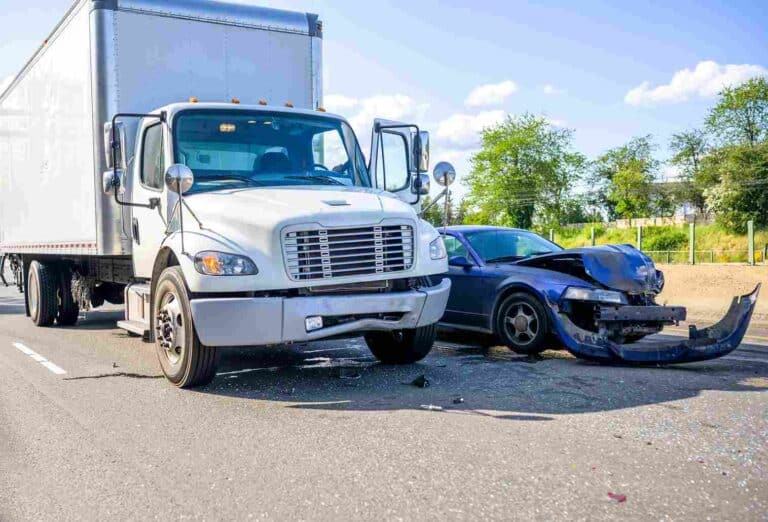




Truck accident cases often require more evidence than ordinary car accident claims. A collision involving a commercial truck may raise questions about the driver, the trucking company, vehicle maintenance, hours of service, cargo loading, and federal safety requirements.
Some of that information may be available at the accident scene, while the trucking company or third parties control other records.
Knowing what evidence may matter can help injured people understand why a truck accident investigation should begin as soon as reasonably possible. Our Connecticut truck accident lawyers can help identify which records may be important, determine who controls them, and take steps to preserve relevant evidence.
1. Police Reports and Crash Documentation
The police report is often one of the first documents reviewed after a serious truck accident.
A crash report can contain important information about the people and vehicles involved, where the collision happened, and what responding officers observed.
Depending on the circumstances, the report may include:
- The date, time, and location of the accident
- Driver and vehicle information
- Insurance information
- Statements from drivers and witnesses
- Road and weather conditions
- Diagrams of the collision
- Citations issued at the scene
A police report does not necessarily decide who is legally responsible for an accident. However, it can provide valuable information that helps attorneys identify witnesses, vehicles, insurance carriers, and other evidence that should be investigated.
Photographs taken by responding officers and supplemental police materials may also be useful.
Schedule a free legal consultation with our personal injury team.
2. Electronic Data From the Truck
Commercial trucks can generate several types of electronic information.
It is important to understand that an electronic logging device, or ELD, is not the same thing as a vehicle’s event data or engine information system.
An ELD is primarily used to record a commercial driver’s duty status and hours of service. Under federal regulations enforced by the Federal Motor Carrier Safety Administration (FMCSA), motor carriers must retain ELD records of duty status and supporting documents for six months.
Depending on the truck and its equipment, other onboard systems may contain information related to vehicle operation.
Potential electronic evidence may include information about:
- Driver hours and duty status
- Vehicle location
- Travel times
- Speed-related data
- Brake applications
- Engine activity
- Vehicle fault codes
The exact information available depends on the truck, manufacturer, installed systems, and circumstances of the crash.
This evidence may help answer important questions. Was the driver operating for too many hours? Was the vehicle moving at an unusual speed? Were there mechanical warnings before the collision?
Because some electronic records are kept only for limited periods, identifying and preserving relevant data can be an important early step.
3. Driver Logs and Driver Qualification Records
Truck drivers and motor carriers are subject to federal safety requirements that do not usually apply to ordinary motorists.
One important area involves hours-of-service rules, which are designed to limit how long covered commercial drivers may operate without required rest.
ELD records and related supporting documents may help determine whether a driver complied with those requirements.
An investigation may also include the driver’s qualification records.
Federal regulations require motor carriers to maintain driver qualification files containing specified employment and qualification information. Certain records must be maintained while the driver is employed and for three years after employment ends.
Depending on the case, relevant driver information may include:
- Employment application and driving history
- Commercial driver’s license information
- Motor vehicle records
- Training information
- Medical qualification records
- Prior safety violations
- Required road-test documentation
These records can become especially important when there are questions about whether the trucking company properly evaluated or supervised the driver.
What About Drug and Alcohol Testing?
Federal rules require post-accident drug and alcohol testing in certain commercial vehicle crashes.
For example, FMCSA requires testing after a crash involving a human fatality. Testing may also be required after certain injury or tow-away accidents when the commercial driver receives a qualifying citation.
Test results may therefore become relevant evidence in some truck accident cases, but post-accident testing is not automatically required after every commercial truck collision.
4. Truck Inspection, Repair, and Maintenance Records
Commercial vehicles require regular inspection, repair, and maintenance.
Mechanical problems involving brakes, tires, steering, lights, or other components can contribute to serious accidents.
Federal motor carrier regulations require carriers to maintain specified inspection, repair, and maintenance records for vehicles under their control. FMCSA explains that these records generally must be retained for one year while the vehicle remains under the carrier’s control and for six months after the vehicle leaves the carrier’s control.
Records that may be important include:
- Brake inspection and repair records
- Tire replacement records
- Maintenance schedules
- Mechanic reports
- Vehicle inspection records
- Records of reported mechanical problems
Imagine that a truck’s brakes fail while it is traveling downhill. Maintenance records could help determine whether the problem developed suddenly or whether there were earlier warning signs that should have been addressed.
These records can also help determine who was responsible for maintaining the vehicle. Depending on the circumstances, that may be the trucking company, vehicle owner, leasing company, maintenance contractor, or another party.

5. Cargo and Loading Records
Not every truck accident is caused by the driver.
The way cargo is loaded and secured can affect the handling and stability of a commercial vehicle.
Improperly distributed cargo may make a trailer unstable. Unsecured cargo can shift during transportation, and excessive weight may affect braking and vehicle control.
Depending on the type of shipment, useful evidence may include:
- Bills of lading
- Shipping documents
- Weight records
- Loading manifests
- Cargo securement records
- Photographs taken during loading
- Weigh station information
These documents may help identify who loaded the truck and whether another company was involved in preparing the shipment.
This can matter because the trucking company is not necessarily the only business that may bear responsibility after a commercial vehicle accident.
A shipper, freight company, loading contractor, vehicle owner, maintenance business, or other company could potentially become relevant depending on what caused the collision.
6. Medical Records and Evidence of Your Injuries
Proving how the truck accident happened is only one part of a personal injury case.
You also need evidence showing how the accident affected you.
Medical records can help connect injuries to the collision and document the treatment required during recovery.
Important medical evidence may include:
- Ambulance and emergency room records
- Hospital records
- X-rays, MRIs, and CT scans
- Surgical records
- Doctor and specialist reports
- Physical therapy records
- Prescription information
- Recommended future treatment
Truck crashes can cause significant injuries because of the size and weight difference between commercial trucks and passenger vehicles.
Medical documentation can help show the nature and severity of those injuries.
Financial documentation can be important as well.
If an injury prevents you from working, pay records, employer statements, tax information, and other documents may help establish lost income. When an injury has long-term effects on a person’s ability to work, additional employment and financial evidence may be needed.
7. Photos, Videos, Witnesses, and Accident Scene Evidence
Some of the most useful evidence may come directly from the accident scene.
If you can safely take photographs after a collision, try to document more than just the damage to your own vehicle.
Useful photographs may show:
- All vehicles involved
- Vehicle positions
- Damage to the truck and other vehicles
- Tire marks
- Debris
- Traffic lights and signs
- Road conditions
- Guardrails or barriers
- Visible injuries
Video can be especially valuable.
Depending on where the accident occurred, footage may exist from traffic cameras, nearby businesses, homes, dashcams, or other vehicles.
Witnesses can also provide important information, particularly when the truck driver and injured person give different accounts of what happened.
In a complex collision, attorneys may also work with accident reconstruction professionals who examine physical evidence, vehicle damage, measurements, electronic information, and other data to analyze how the crash occurred.
Why Does Evidence Need to Be Preserved Quickly?
Truck accident evidence does not remain available forever.
This is particularly important with commercial trucking records because federal regulations set specific retention periods for certain documents.
For example, FMCSA requires carriers to retain ELD records of duty status and supporting documents for six months.
Maintenance records also have defined retention requirements.
Other evidence can disappear for practical reasons. Surveillance footage may be automatically overwritten. Vehicles may be repaired. Witnesses can become more difficult to locate.
For this reason, attorneys may send a preservation request identifying records and electronic information that could be relevant to a potential injury claim.
This does not mean evidence will automatically disappear or that every trucking company will fail to preserve important information. It means that identifying relevant evidence early can reduce the risk that useful information is lost through ordinary record-retention practices.
Who May Be Responsible for a Truck Accident?
Truck accident cases can involve more potential defendants than a typical passenger vehicle collision.
Depending on the evidence, potentially responsible parties may include:
- The truck driver
- The motor carrier
- The vehicle owner
- A maintenance contractor
- A cargo-loading company
- A shipper
- A manufacturer of a defective vehicle or component
Not every accident involves all of these parties.
The purpose of an investigation is to determine what caused the collision and which people or businesses may be legally responsible.
For example, driver logs may point toward fatigue, while maintenance records may reveal a mechanical issue. Cargo records may instead show that an improperly loaded trailer contributed to the crash.
That is why collecting different categories of evidence is so important.
Can You Get Trucking Company Records Yourself?
Some evidence is relatively easy for an injured person to collect, such as photographs, medical bills, or witness contact information.
Obtaining trucking company records can be more complicated.
Driver qualification records, ELD information, internal company documents, inspection records, maintenance records, and electronic vehicle information may require formal requests and, once litigation begins, the discovery process.
An attorney may also send preservation correspondence before filing a lawsuit when there is reason to believe particular records could become important.
There is no rule that only an attorney can ever request truck-related evidence. Still, legal assistance can be valuable when identifying what records exist, who controls them, and how they can be obtained.
How Jonathan Perkins Injury Lawyers Can Help With a Truck Accident Case
Truck accident investigations often involve evidence from several sources, including the trucking company, the driver, medical providers, witnesses, government agencies, and third-party businesses.
At Jonathan Perkins Injury Lawyers, we represent people injured in commercial truck accidents in Connecticut. We offer free case evaluations and are available 24/7 to speak with injured people and their families.
Depending on the facts of your case, we can investigate the collision, identify important evidence, and evaluate the parties that may be responsible.
We may help by:
- Obtaining police and crash records
- Identifying relevant trucking records
- Requesting preservation of electronic information
- Reviewing ELD and hours-of-service records
- Examining driver qualification information
- Obtaining inspection and maintenance records
- Reviewing cargo and shipping documents
- Collecting medical and financial documentation
- Interviewing witnesses
- Working with qualified experts when appropriate
- Communicating with insurance companies
- Negotiating a settlement or filing a lawsuit when necessary
Truck accident claims can also involve multiple businesses and insurance policies. We can review the available evidence to determine whether responsibility may extend beyond the truck driver to a motor carrier, vehicle owner, maintenance provider, cargo company, or another party.
Contact Jonathan Perkins Injury Lawyers to request a free consultation about a Connecticut truck accident claim.